
New laminate options build on Featurecraft’s established plywood and real timber veneer offering, giving project teams more ways to match materials to the needs of each interior.
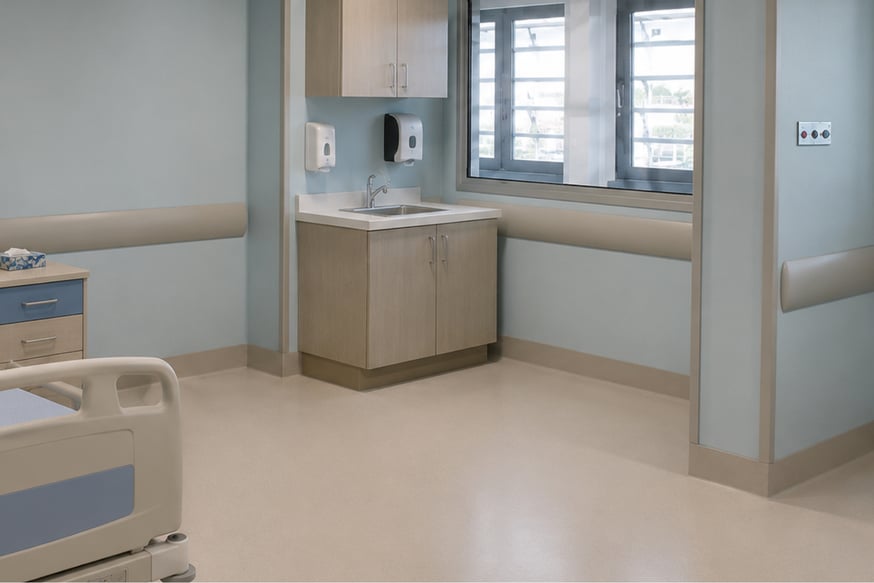
Interior projects rarely rely on one surface or one panel type.
Cabinetry, wall linings, counters, furniture, partitions and work surfaces may all sit within the same design, yet each can require a different balance of appearance, durability, maintenance, fabrication and cost.
Featurecraft has expanded its interior surface offering with the addition of HPL, LPL and compact laminate, complementing its existing range of plywood and real timber veneer panels.
Together, these materials give architects, designers and joiners more options to resolve different applications, while maintaining a considered and connected design direction across the wider project.
More options for more applications
Each material brings something different.
Real timber veneer offers natural grain, warmth and variation. Plywood brings material honesty, visual depth and the opportunity to make the exposed edge part of the design. LPL provides an efficient, ready-finished panel for general joinery. HPL offers a durable decorative surface for higher-use applications, while compact laminate suits slimmer, self-supporting and selected moisture-prone environments.
These materials are not intended to compete with one another. Their value lies in giving project teams a broader set of tools to work with.
A project might use real timber veneer for feature joinery, plywood where the edge and substrate form part of the aesthetic, LPL for cabinetry and storage, HPL for counters and frequently used surfaces, and compact laminate for partitions, work surfaces or finer-profile details.
That flexibility makes it easier to select each material around the needs of the application, rather than forcing one product to work across every area of the interior.
Understanding the laminate range
The new laminate range introduces three distinct material formats.
HPL is a thin decorative laminate bonded to a suitable substrate. Its hardwearing surface makes it well suited to cabinetry, doors, wall linings, furniture, counters and other frequently used interior elements.
Because the laminate is applied to a selected board, the overall panel can be considered in relation to thickness, substrate, edge treatment and fabrication requirements.
LPL is supplied as a ready-finished decorative board, making it a practical option for shelving, storage, cabinetry and general interior joinery.
With the surface already bonded to the panel, it offers a straightforward route into cutting, edging and assembly, particularly across larger areas or repeated joinery components.
Compact laminate is a dense, self-supporting sheet that does not require a separate substrate. It is suited to applications such as partitions, lockers, cubicles, tabletops, shelving, work surfaces and selected moisture-prone areas.
Its exposed core can also become part of the finished detail, creating a slimmer and more architectural result than a conventional built-up panel.
Across HPL, LPL and compact laminate is a broad selection of solid colours, timber reproductions, stone and material-inspired decors and tactile surface textures.
This creates more scope to shape the character of an interior while selecting the format that best suits the practical demands of each application.
A broader decorative and material palette
The expanded range gives designers more ways to approach colour, texture and materiality across a project.
Some interiors call for the natural variation and authenticity of real timber veneer. Others benefit from the consistency and durability of laminate. In many projects, the strongest result will come from using both.
A timber-look laminate might support general cabinetry, while real timber veneer is reserved for feature elements where the depth and variation of natural grain are most valuable.
Plywood may be introduced where the exposed edge contributes to the design, while HPL or compact laminate is used in areas requiring greater resilience or a different panel construction.
This allows the material palette to respond more intelligently to both the visual intent and the way the interior will be used.
A more complete approach to specification
The expanded offering gives project teams more than additional finishes to choose from.
It provides a clearer way to consider appearance, performance and panel construction together.
Featurecraft can work with architects, designers, contractors and joiners to help compare suitable material options, review intended applications and consider practical details such as substrates, thicknesses, edge treatments, fabrication and sample availability.
That support can be particularly valuable early in the project, when there is still flexibility to test ideas, compare alternatives and resolve the material strategy before documentation and build.
Rather than beginning with a product and trying to make it fit, the process can begin with the project requirement and work towards the most appropriate surface solution.
More choice, with a clearer purpose
The addition of HPL, LPL and compact laminate strengthens Featurecraft’s wider interior surface offering without replacing its established plywood and real timber veneer options.
Together, these materials provide more ways to respond to the varied design, performance and practical requirements of an interior.
The value is not simply in having a larger range.
It is in being able to offer more suitable solutions across more parts of a project, while helping the overall material palette remain cohesive, practical and well considered.
To explore the Featurecraft surface range, request samples or discuss an upcoming project, contact the Featurecraft team.