
Compliance for Decorative Joinery
Aesthetic design can sometimes feel like a ‘two steps forward, one step back’ process. You create a visual scheme and begin specification, only to run into code compliance issues. So, you make a few tweaks here and there, adjust your designs, and then before you know it, the end result isn’t what you intended at all.
It’s frustrating – and it’s unnecessary.
As a boutique joinery company, Featurecraft has spent a long time walking the tightrope between code compliance and aesthetic beauty. We know the pain points and the misconceptions that make the whole process so stressful, and we know how to eliminate them. In this article, we’ll try to distill our knowledge into a few simple points, focusing on the topic that can be trickiest: fire safety.
A quick summary of relevant Building Code clauses
There are several clauses that might apply to non-structural decorative joinery:
1. Clause B2: Durability – obviously, you don’t want to be using products that fall apart quickly. Look for decorative finishes with a minimum guaranteed lifespan of five years.
2. Clauses C1-C4: Fire Safety – this is the main concern for decorative joinery, especially for products made of timber.
- We’ll cover this in more detail through the rest of the article.
3. Clause D1: Access Routes– your product cannot impede safe movement through critical passageways. Work with your supplier to estimate how much the feature will project into your space.
4. Clause E2: External Moisture – if you’re dealing with doors, windows, and other interior-exterior boundary elements, you’ll need to ensure that your product is weathertight.
5. Clause E3: Internal Moisture – for products installed in damp or condensation-prone areas like bathrooms, you’ll need proof of moisture resistance and ventilation.
6. Clause F4: Safety from Falling – no one wants to be hit on the head by a loose batten. Always double-check that you’re ordering products from a reputable supplier who can guarantee that their joins and fixing systems are stable.
7. Clause G6: Acoustics – if you’re working in sound-sensitive areas like residential complexes, you need to be sure that your feature won’t degrade acoustic performance.
As you work through the specification process, keep these clauses in mind. If you’re looking at products that don’t clearly address these code requirements, you’re probably looking in the wrong place.
Note, however, that this article acts as a generic guide and may not apply to your specific environment. Always consult our joinery specialists before making important code-related decisions.
A General Guide to Fire Safety
For decorative interior products like battens and panels, you’ll primarily need to apply Clause C3 – Fire Affecting Areas Beyond the Source – with a focus on Clause 3.4(a) for internal surface linings.
Decorative products are tested for fire safety and assigned a Material Group Number that goes from 1 (the lowest fire spread rate) to 4 (the highest fire spread rate), with the –S suffix attached for materials with a low smoke growth rate.
Contrary to popular belief, you do not always need to specify a Group 1-S product. For example, you can incorporate solid timber battens across walls and ceilings in a residential lobby, despite solid timber only achieving a Group 3 rating.
This table, taken from the Acceptable Solutions C/AS2 Document prepared by MBIE, summarises the general Material Group requirements for architectural environments:
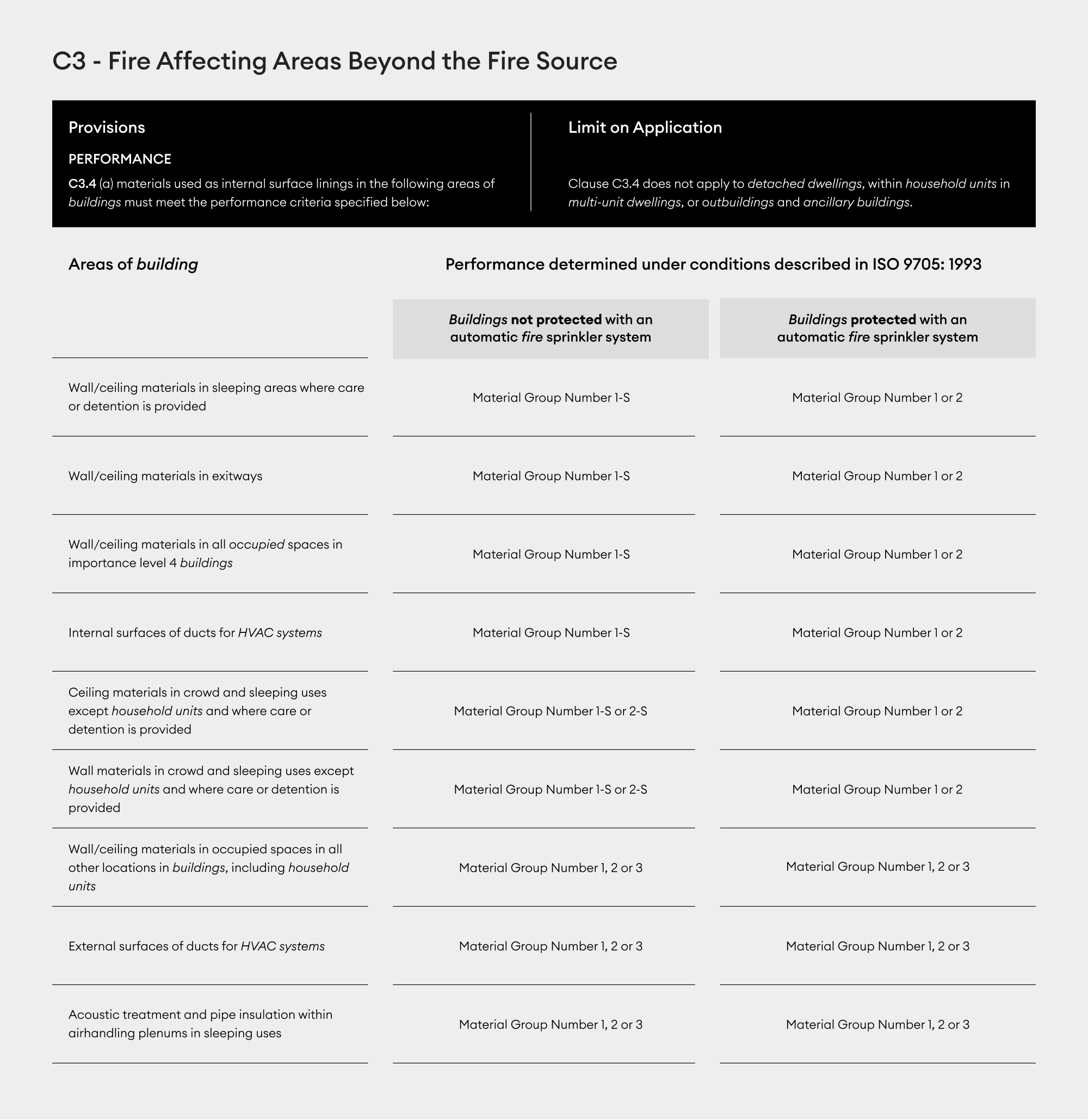
Note: 'importance level 4’ refers to buildings that are critical for post-disaster functions.
What to do if you require a Material Group 1-S product
Yes, this may restrict your options a little – but it doesn’t mean that timber-based products are out the window. If your design scheme hinges on using solid timber, then we can easily modify your product by applying intumescent coating, which swells upon exposure to heat and creates a protective layer of insulation. Alternatively, we can recommend base materials like fire-rated MDF, with dozens of veneer options to satisfy your visual desires. Furthermore, we can apply a coating of up to 0.4mm thickness (e.g. a waterborne or solvent-based paint) without compromising the fire safety. We can also engrave products for aesthetic effect and this will not impact the Material Group.
Making choices at a supplier level
Many suppliers offer baseline guarantees that help you meet code compliance no matter which product you select. For example, all of Featurecraft’s decorative timber products come with a minimum five-year warranty, ensuring that you can fulfil Clause B2.
It also helps to pick suppliers who specialise in areas like acoustic performance, as these products are likelier to enhance your environment’s sound quality instead of degrading it.
Finally, pay attention to industry chatter about suppliers, and follow your gut. Your supplier should be able to provide you with proof that their systems are appropriately stable, durable, and safe for your environment, and they should be taking an active role in your design process, pointing out any potential issues or vulnerabilities that need to be addressed. When the supplier isn’t invested in the process, there’s a greater risk of negligence and non-compliance. Choose these key relationships carefully.
Create without limits
This is our key message for you: as a designer, you have plenty of beautiful, functional, code-compliant options for decorative timber joinery. Yes, the Building Code is extremely important and requires total compliance, but this isn’t hard to achieve – when your supplier’s been in the industry for so long, it’s easy to give them your design intent and let them do their magic.
Browse our decorative timber pieces here, access technical resources and code compliance certifications here, or contact our specialist team and let us take care of everything.


